Categorías
Recomendador de libros
Dinos qué te gusta y te recomendamos qué leer
Los libros más deseados
Compra online los libros más deseados por nuestros clientes
Novedades en libros. Noviembre de 2026
Todas las novedades editoriales de noviembre de 2026
Listas de libros recomendados
Novedades, sagas y recomendaciones por temáticas

Nuestras librerías
ELIGE TUS LIBROS ¡EL ENVÍO ES GRATIS!*
* Envíos desde 18€ para España y Portugal peninsulares, Tenerife, Gran Canaria y Mallorca
Libros de Very Short Introduction

Modernism: A Very Short Introduction
- 117 páginas
- Modernism ushered in some of the most exciting innovations in art and literature, from Fauvism,..
12,56€11,94€
Madness: A Very Short Introduction
- 134 páginas
- Madness is something that frightens and fascinates us all. It is a word with which we are universally familiar, and a condition that haunts the human imagination. Through the centuries, in poetry and in prose, in drama and in the visual arts, its depredat...
12,56€11,94€
Modern France
- 140 páginas
- In this Very Short Introduction, Vanessa Schwartz argues that modern France, as both a world stage..
12,56€11,94€
Conscience: A Very Short Introduction
- 144 páginas
- From Cicero and Augustine through the middle ages and into the Reformation, this Very Short..
12,56€11,94€
Late Antiquity: A Very Short Introduction
- 128 páginas
- Late antiquity: decline or transformation, conflict or interaction? Late antiquity is the period (c.300 - c.800) in which barbarian invasions ended Roman Empire in Western Europe by the fifth century and Arab invasions ended Roman rule over the eastern...
12,56€11,94€
The Computer: A Very Short Introduction
- 139 páginas
- What is the basic nature of the modern computer? How does it work? How has it been possible to..
12,56€11,94€
Organizations: A Very Short Introduction
- 156 páginas
- Organizations are everywhere. We meet them on every street corner in the form of families and..
12,56€11,94€
Agnosticism: A Very Short Introduction
- 152 páginas
- What is agnosticism? Is it a belief, or merely the absence of belief? Is it the result of too..
12,56€11,94€
Literary Theory: A Very Short Introduction
- 165 páginas
- What is literary theory? Is there a relationship between literature and culture? In fact, what is literature, and does it matter? These are some of questions addressed by Jonathan Culler in this Very Short Introduction to literary theory. Often a controve...
12,56€11,94€
The Soviet Union: A Very Short Introduction
- 144 páginas
- The Soviet Union at its height occupied one sixth of the world's land mass, encompassed fifteen republics, and stretched across eleven different time zones. More than twice the size of the United States, it was the great threat of the Cold War until...
12,56€11,94€
Scotland
- 144 páginas
- This Very Short Introduction explores the key themes from more than 1,000 years of Scotland's fascinating history. Covering everything from the Jacobites to devolution to the modern economy, this concise account presents a fully-integrated picture...
12,56€11,94€
Old Testament
- 208 páginas
- A compact and informative introduction to the Old Testament, written by a leading authority on the Bible. It provides an overview of one of the pillars of Western religion and culture, whose significance has endured for thousands of years.
12,56€11,94€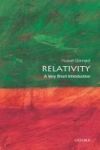
Relativity: A Very Short Introduction
- 144 páginas
- If you move at high speed, time slows down, space squashes up and you get heavier. Travel fast enough and you could weigh as much as a jumbo jet, be flattened thinner than a CD without feeling a thing-and live forever! As for the angles of a triangle,...
12,56€11,94€
Great Depression -very Short Introductio
- In the middle of the great, global twentieth-century crisis, the Great Depression forced the United States to adopt policies at odds with its political traditions. This very short introduction to that crisis and those policies provides readers with a ....
12,56€11,94€
German Literature: A Very Short Introduction
- 171 páginas
- German literature in all genres and from all historical periods has exerted an enormous influence on the history of western thought. From Martin Luther, Frederick Schiller, and Johann Wolfgang von Goethe to Karl Marx, Sigmund Freud, Thomas Mann, Bertolt...
12,56€11,94€
Quakers
- The Quakers are a fascinating religious group both in their origins and in the variety of reinterpretations of the faith since. This Very Short Introduction charts the history of Quakerism and its present-day diversity, and outlines its approach to wo...
12,56€11,94€
Classical Mythology: A Very Short Introduction
- 144 páginas
- From Zeus and Europa, to Diana, Pan, and Prometheus, the myths of ancient Greece and Rome seem to exert a timeless power over us. But what do those myths represent, and why are they so enduringly fascinating? Why do they seem to be such a potent way of...
12,56€11,94€
Economics
- 172 páginas
- Here Partha Dasgupta, an internationally recognized authority in economics, presents readers with a solid introduction to its basic concepts, including efficiency, equity, sustainability, dynamic equilibrium, property rights, markets, and public goods....
12,56€11,94€
The Renaissance: A Very Short Introduction
- 148 páginas
- More than ever before, the Renaissance stands as one of the defining moments in world history. Between 1400 and 1600, European perceptions of society, culture, politics and even humanity itself emerged in ways that continue to affect not only Europe but...
12,56€11,94€
African History: A Very Short Introduction
- 165 páginas
- This Very Short Introduction looks at Africa's past and reflects on the changing ways it has been imagined and represented, both in Africa and beyond. The author illustrates important aspects of Africa's history with a range of fascinating historical...
12,56€11,94€